


Learning how to launch B2B SaaS without funding transforms constraints into competitive advantages. For bootstrapped founders who believe you need venture capital, this silent launch framework changes everything about product launches. This isn’t another marketing playbook requiring budgets and teams—it’s a systematic approach that leverages community, partnerships, and product-led growth to build sustainable businesses from day one.
For bootstrapped founders who believe you need venture capital to launch B2B software, this framework will change everything you know about product launches. This is not another marketing playbook requiring budgets and teams; it’s a silent, systematic approach that turns constraints into competitive advantages.
Why Traditional B2B SaaS Launches Fail Bootstrapped Founders
The standard B2B SaaS launch blueprint is fundamentally broken for founders without funding. It assumes resources that don’t exist: marketing budgets for pre-launch buzz, sales teams for outbound campaigns, and capital for relentless advertising. The result? Most bootstrapped founders either delay launching indefinitely or burn through personal savings replicating venture-backed tactics that were never designed for them.
The silent launch framework operates on a different principle: Minimal audience, maximum impact. Instead of shouting into crowded markets, you systematically build a product that your first 10 ideal customers cannot live without. Your launch becomes not an event, but an inevitable conclusion to months of quiet, strategic work.
The Silent Launch Framework Philosophy
Core Principles:
- Community Before Product: Your first customers come from relationships, not advertising.
- Partnerships Over Promotion: Leverage existing audiences rather than building your own from zero.
- Product as Marketing: Your software’s value must be so apparent it markets itself.
- Profit from Day One: Revenue funds growth, not investor capital.
- Stealth as Strategy: Competition notices loud launches; they often miss quiet excellence.

The Mathematics of Silent Launches:
- Traditional Launch: $50k marketing budget → 1,000 signups → 10 paying customers = $5,000 cost per customer
- Silent Launch: $0 marketing budget → 100 targeted conversations → 10 paying customers = Relationship-based growth
Phase 1: Community Building (6-12 Months Pre-Launch)
Step 1: Identify Your Minimum Viable Audience
Your goal isn’t to reach everyone, it’s to become indispensable to someone specific.
Action Framework:
- Niche Definition: “B2B SaaS for e-commerce” is too broad. “Inventory management SaaS for Shopify stores doing $500k-$2M annually” is targetable.
- Audience Mapping: Where do 100 of your ideal customers already gather? (Specific LinkedIn groups, niche forums, industry Slack communities)
- Value-First Participation: Join these communities with zero promotion intent. Your metric: 3 months of pure contribution before mentioning your product.
Step 2: The 100:10:1 Relationship Framework
text
100 Genuine Conversations → 10 Beta Testers → 1 Case Study
Execution:
- Months 1-3: Provide value in communities (answer questions, share insights)
- Months 4-6: Identify pain points through conversations (not surveys)
- Months 7-9: Recruit 10 beta testers from strongest relationships
- Months 10-12: Co-create solution with beta group
Real Example:
A founder building accounting SaaS for freelancers spent 8 months answering tax questions in freelance Facebook groups. By launch, 47 group members had already agreed to be paying customers because they’d received months of free value first.
Phase 2: Strategic Partnership Development
The Partnership Stack:
Layer complementary relationships that share audiences but don’t compete.
Tier 1: Content Partners
- Industry blogs needing expert contributors
- Podcasts serving your target audience
- Newsletter publishers with relevant subscribers
Tier 2: Integration Partners
- Complementary tools your audience already uses
- Platforms with API access and partner programs
- Services that solve adjacent problems
Tier 3: Referral Partners
- Consultants serving your ideal customers
- Agencies with complementary offerings
- Industry influencers with trusted audiences
Partnership Proposal Template:
Partnership Email Template
Hi [First Name],
I’ve noticed you help [their audience] with [specific problem].
I’m building [Your SaaS] which solves [complementary problem].
Proposal: I’d like to [specific collaboration] that provides your audience with [clear benefit] while naturally introducing my solution.
No money exchanged—pure value exchange. Are you open to a 15-minute chat?
Best,
[Your Name]
Founder, [Your SaaS]
Copy and customize this template for your partnership outreach.

Phase 3: Product-Led Growth Mechanics
Building the Self-Marketing Product:
Your software must demonstrate value before requiring commitment.
Essential PLG Components:
- Instant Value: First-use delivers tangible benefit within 5 minutes
- Transparent Pricing: Clear path from free to paid without sales calls
- Built-in Virality: Natural sharing mechanisms (collaboration features, result sharing)
- Progressive Disclosure: Advanced features reveal themselves as users need them
The Silent Onboarding System:
text
Landing Page → Immediate Tool Access → Guided First Task → Value Demonstration → Natural Upgrade Path
Critical Difference: Traditional onboarding explains features; silent onboarding delivers immediate results.
Example Implementation:
A project management SaaS skips feature tours. Instead, it automatically creates a sample project using the visitor’s company name with: “Welcome [Company] team! Here’s how you’d track your Q4 marketing campaign.” Instant relevance, zero explanation needed.
Phase 4: Execution: Launching in Stealth Mode
The Non-Launch Launch Timeline:
Week 1: Partner Network Activation
- 5-7 partnership integrations go live simultaneously
- Co-content published across partner channels
- Existing community relationships receive personal invitations
Week 2: Community Soft Launch
- Beta users become public references (case studies, testimonials)
- Community members who helped shape product get exclusive access
- Organic discussion begins in established groups
Week 3-4: Organic Momentum Building
- First user-generated content appears (unsolicited)
- Integration partners mention your tool to their audiences
- Search traffic begins from long-tail, problem-specific queries
What You’re NOT Doing:
- No press releases
- No launch events
- No paid advertising
- No cold outreach
- No “big announcement” social media blasts
Launch Metrics That Matter:
- Partner-generated signups: 30-40% of initial users
- Community-referred users: 40-50% of initial users
- Organic discovery: 10-20% of initial users
- Week 1 revenue: Should cover monthly operating costs
- Week 4 retention: >85% of Week 1 users still active
Phase 5: Post-Launch: Growing Without Marketing Spend
The Silent Growth Flywheel:
text
Existing Users → Product Improvements → Better Results → Organic Advocacy → New Users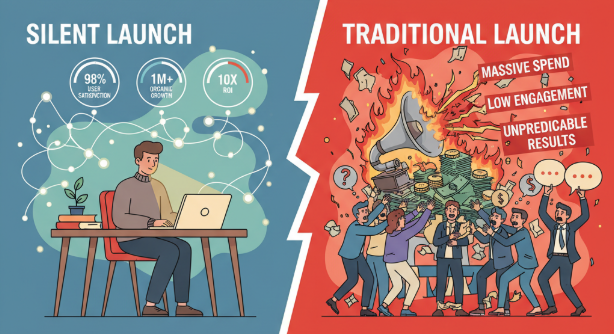
Maintenance Activities:
- Weekly: Engage with every new user personally for first 4 weeks
- Bi-weekly: Publish case study of successful customer
- Monthly: Add one new integration/partnership
- Quarterly: Release major feature based on user requests
Scaling Without Spending:
- Content: Repurpose user success stories into blog posts
- Distribution: Leverage partner channels (not paid ads)
- Sales: Product sells itself; your role is facilitating success
- Support: Build comprehensive help content from common questions
When to Break Silence:
Only when you have:
- 50+ paying customers
- 6+ months of runway from revenue
- 3+ detailed case studies
- Natural search traffic for problem keywords
Then and only then consider modest, targeted content marketing.
Tools & Resources for Silent Launches
Essential Stack (<$100/month):
- Community Building: Circle.so or Discord (free tiers)
- Product Analytics: PostHog or Plausible (self-hosted options)
- Communication: ConvertKit for email (free up to 1,000 subscribers)
- Documentation: GitBook or Notion (free tiers)
- Feedback: Canny or plain Typeform (free options)
Process Templates:
- Beta Tester Agreement (simple Google Doc)
- Partnership Tracking Sheet (Airtable base)
- User Interview Questionnaire (structured conversation guide)
- Launch Sequence Checklist (day-by-day execution plan)
Common Pitfalls & How to Avoid Them
Pitfall 1: Premature Scaling
Symptoms: Adding features for hypothetical future users instead of serving current ones.
Solution: Implement the “10x Rule”, any new feature must deliver 10x value to existing users before considering expansion.
Pitfall 2: Partnership Imbalance
Symptoms: Doing all the work while partners reap benefits.
Solution: Use the “Give 3, Ask 1” framework provide three pieces of value before requesting one reciprocal action.
Pitfall 3: Invisible Success
Symptoms: Users love your product but no one knows.
Solution: Systematize testimonial collection. After any positive interaction: “Would you be willing to share this feedback publicly? Here’s a simple form.”
Pitfall 4: Growth Paralysis
Symptoms: Waiting for “perfect” before moving forward.
Solution: Set “good enough” criteria for each phase. Launch when you have 10 paying customers who would be disappointed if you disappeared, not when you’ve built every possible feature.
The Silent Launch Mindset Shift
Traditional B2B SaaS launches operate from scarcity; scarcity of attention, scarcity of funding, scarcity of time. They shout into crowded rooms, hoping someone will notice through the noise. They burn capital to buy visibility, hoping conversions will follow. They race against venture-backed timelines, hoping to scale before funding runs out.
The silent launch framework operates from abundance; abundance of genuine relationships, abundance of focused attention, abundance of sustainable growth. It doesn’t ask “How do we get noticed?” but “How do we become indispensable?” It doesn’t seek the spotlight but builds in the workshop. It measures success not in launch day spikes but in month-over-month retention.
The mathematics are undeniable:
- Traditional launch: $50,000 marketing spend → 1,000 signups → 10 paying customers = $5,000 cost per customer
- Silent launch: 6 months of community building → 100 genuine relationships → 10 co-creating customers = Profit from day one
This isn’t just a different strategy, it’s a different philosophy. One that respects your constraints (no funding, small team, limited time) and transforms them into competitive advantages. While funded companies chase vanity metrics and press coverage, you’re building something more valuable: a sustainable business where every customer arrives through genuine need, not clever marketing.
Your Launch Decision Point
You now face a choice:
- Replicate the broken model: Delay launching until you have resources you may never get, then spend those resources on tactics designed for companies with different constraints.
- Embrace the silent framework: Start today with what you have, your expertise, your network, your ability to solve a specific problem for a specific someone.
The companies in our upcoming case studies chose option two. They launched with teams of one, budgets of zero, and timelines measured in relationships, not quarters. They became case studies not because they were exceptional, but because they were systematic.
The silent launch begins not with a funding round or a marketing plan, but with a conversation. Your first customer is already experiencing the problem you solve. Your job isn’t to interrupt them with advertising, it’s to find them, understand them, and build exactly what they need.
The era of loud launches funded by venture capital is ending. The era of silent, sustainable, customer-funded growth has begun. Your framework is ready. Your first community member is waiting. Begin.
Continue Your Implementation Journey
Apply your silent launch knowledge with these essential companion guides:
Comprehensive resources to support your bootstrapped launch journey.
What’s Next in This Series
“Silent Launch Case Studies: 3 Bootstrapped B2B SaaS That Grew to $50k MRR Without Funding”
Real-world examples of this framework in action. Analysis of how actual companies implemented silent launches successfully.
This case study will be published in our Business Strategy category.




good
perfect