
Why Your SaaS Pricing Strategy Is Your Most Important Business Decision
Getting your SaaS pricing strategy right from the start isn’t just about revenue, it’s about survival. Price too high, and you’ll scare away early adopters; price too low, and you’ll struggle to fund growth, creating a cycle of stress that derails many promising ventures. This guide cuts through the complexity to show you a practical framework for pricing your first SaaS product, grounded in timeless psychological principles rather than guesswork.
Many founders make the critical mistake of viewing pricing as a simple math problem, when in reality, it’s a multifaceted signal that communicates your product’s value, positions you in the market, and directly impacts your ability to scale sustainably. A well-structured SaaS pricing strategy serves as a strategic asset, influencing everything from customer perception to your company’s long-term valuation.
The Foundational Pillars of a Winning SaaS Pricing Strategy
Before you pick a number, you must understand the three core pillars that support any effective pricing model. Ignoring these is why most first-time pricing attempts fail.
1. Value-Based Pricing: The North Star
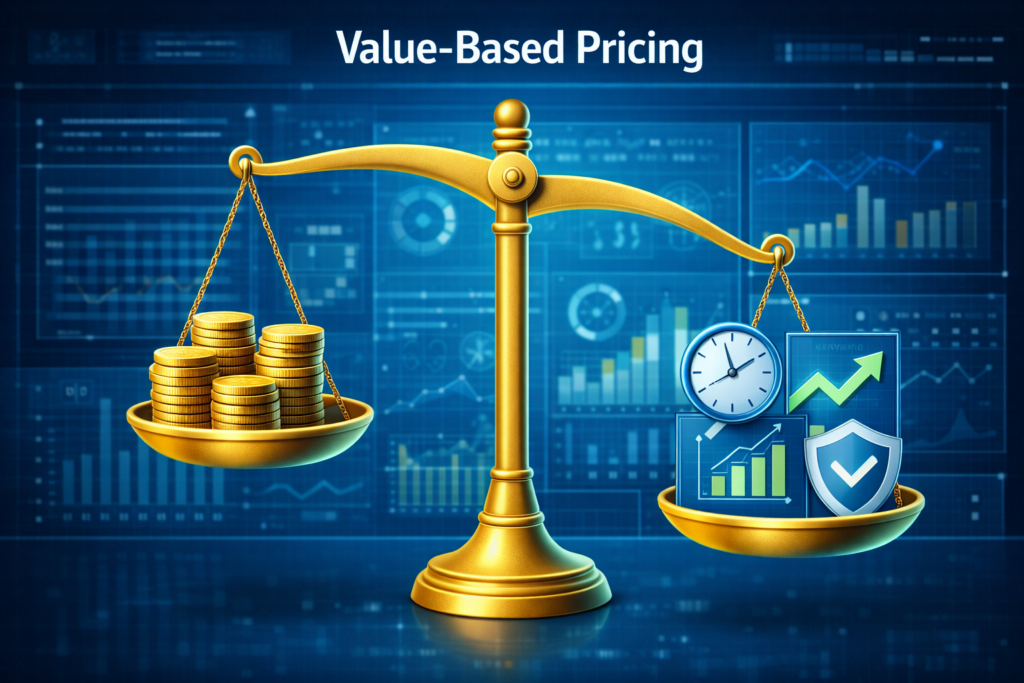
Forget calculating costs and adding a margin. The most successful SaaS pricing strategy starts by quantifying the value you deliver to the customer. Ask: What problem are you solving, and what is that solution worth in terms of time saved, revenue increased, or risk mitigated for your user? Your price should be a fraction of the value you create. When your financial model isn’t burdened by traditional debt or heavy capital costs, you gain the flexibility to align your price more closely with customer value rather than being forced to cover high fixed financing expenses.
2. The Psychology of Price Perception
Humans are not rational calculators. Our perception of price is influenced by cognitive biases. Two of the most powerful for SaaS are:
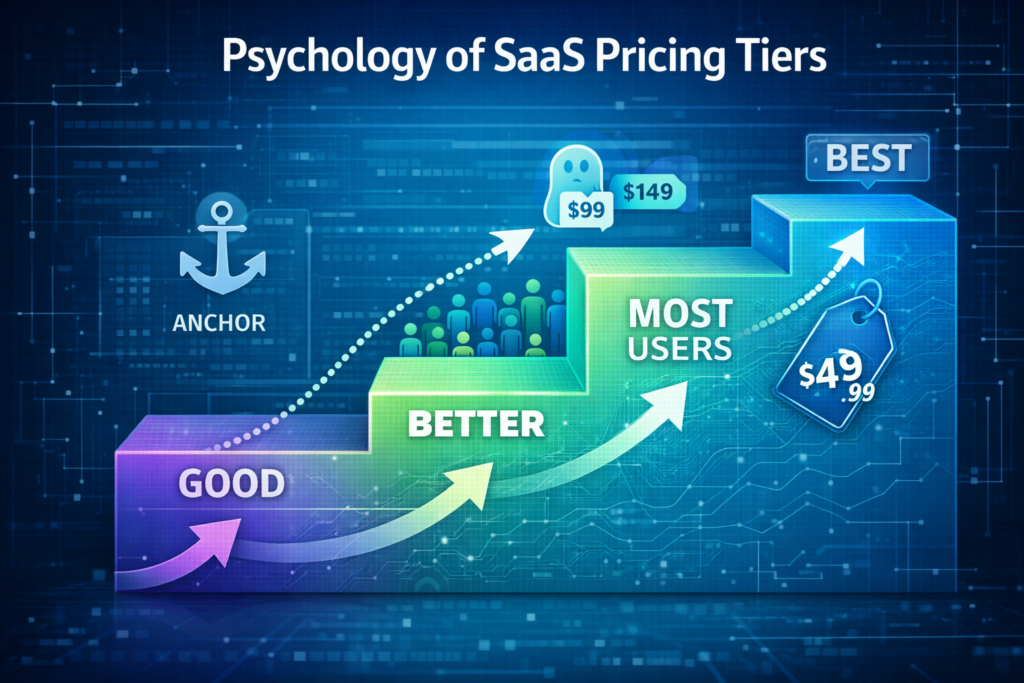
- Price Anchoring: Presenting a higher-priced option first makes other options seem more reasonable.
- The Rule of 99: Prices ending in .99 or .95 are perceived as significantly lower than rounded numbers, even with a one-cent difference.
These principles are why you often see three-tiered plans (Basic/Pro/Enterprise) in SaaS pricing models. The middle tier is usually the “anchor” designed to be the most popular choice.
3. Aligning Price with Your Business Model
Your price must fuel your chosen path to growth. A bootstrapped company targeting niche businesses will have a different pricing structure than a venture-backed company chasing blitz scaling in a broad market. Your pricing should directly support your customer acquisition costs (CAC), lifecycle, and overall monetization strategy.
The 6-Step Framework to Set Your First Price
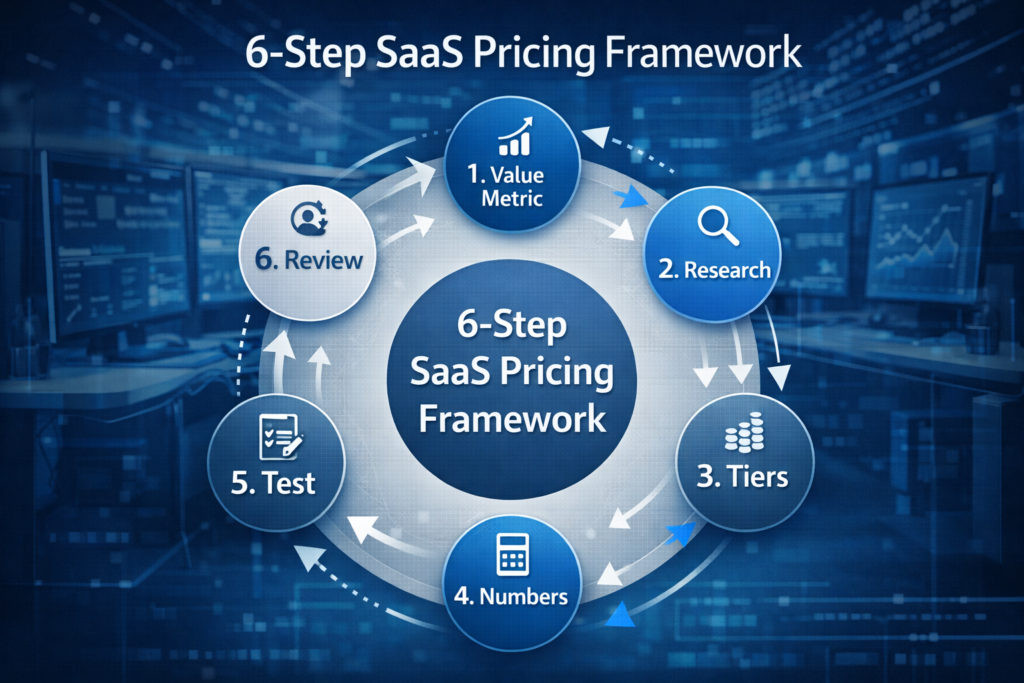
This actionable six-step process will help you move from uncertainty to confidence.
Step 1: Define Your Primary Value Metric
Your value metric is what you charge for (e.g., per user, per project, per GB of storage). It must align with how your customers perceive value. If value grows with team size, charge per user. If value is in data processed, charge per unit of data. The right metric scales with your customer’s success.
Step 2: Research the Competitive Landscape (Then Ignore It)
Analyze competitor pricing, but don’t copy it. Use this research to understand market expectations and identify gaps. Are competitors all targeting enterprises? There might be an opportunity with a simplified, lower-cost plan for small teams. This is where a capital-efficient approach can be advantageous, allowing you to serve underserved segments without the pressure to match bloated competitor prices designed to satisfy investor returns.
Step 3: Craft Your Pricing Tiers
Start simple. For your first product, we recommend no more than three plans:
- Entry Plan: Removes friction for adoption. Consider a limited free trial or a very low-cost tier.
- Primary Plan: Your “sweet spot.” This should be your flagship offering, delivering core value at a price most target customers will find compelling.
- Premium Plan: For power users. Includes your highest-value features and allows for price anchoring.
For a deeper dive into building a business with minimal upfront capital, which influences pricing freedom. Use a methodical approach to launching with minimal capital.
Step 4: Determine the Actual Numbers
This is the moment of truth. Use value-based estimation: If your tool saves a marketing manager 10 hours a month and their time is worth $50/hour, you’re creating $500 of value. Capturing 20% of that ($100/month) is a great starting point. Validate these numbers through early customer conversations.
Once you have a target price, break-even calculators help translate that number into the customer count needed to cover your fixed and variable costs.
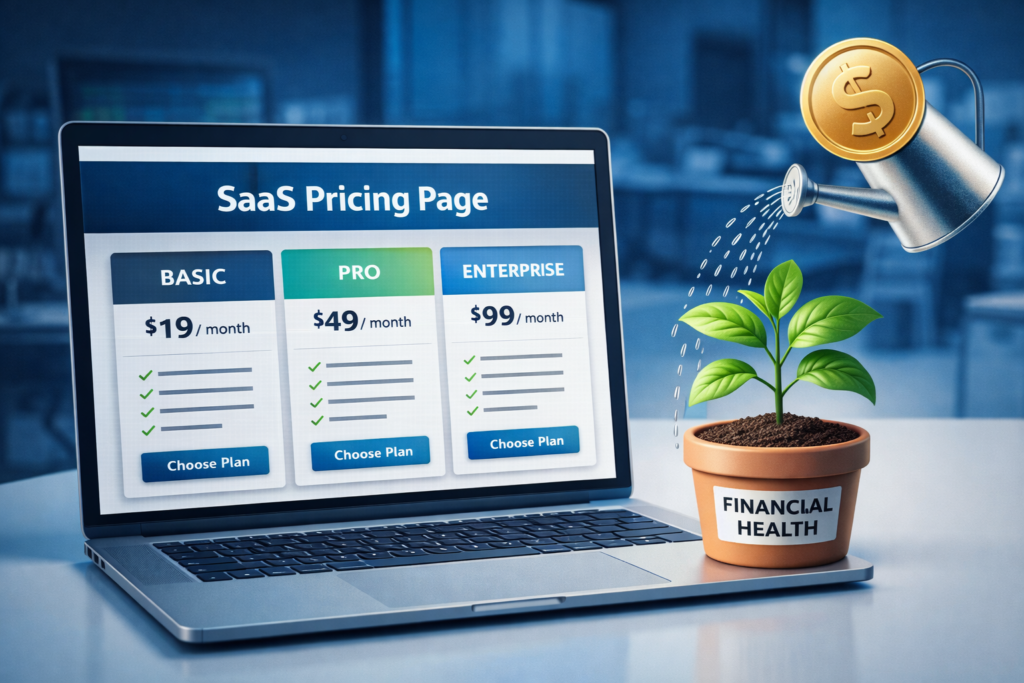
Step 5: Build and Test Your Pricing Page
Your pricing page is your highest-converting salesperson. It must be clear, confident, and easy to understand. Prominently display your Primary Plan, use clear benefit-oriented copy for each tier, and include a clear call-to-action. For insights on keeping other operational costs low to maintain pricing flexibility, Use effective methods for controlling operational overhead.
Step 6: Implement a Review Cycle
Your first price is a hypothesis. Schedule a quarterly review of key metrics: conversion rates, plan uptake, and churn. Be prepared to iterate. As noted by pricing experts at Price Intelligently, companies that systematically revisit pricing grow revenue 20-30% faster.
Common Pricing Traps to Avoid
- The Cost-Plus Trap: Basing your price solely on your costs plus a margin ignores customer value and caps your potential.
- Overcomplicating at Launch: Too many tiers, complex features lists, and confusing metrics create friction. Start simple.
- Fear of Charging: Undervaluing your work attracts price-sensitive customers who churn easily and costs more to support. Confidence in your price signals confidence in your product.
- Ignoring the “Good/Better/Best” Framework: This classic structure, validated by companies like HubSpot, leverages psychology to guide customer choice and maximize revenue.
Connecting Pricing to Your Overall Financial Health
A sustainable SaaS pricing strategy is just one part of a healthy financial foundation. It works in tandem with prudent startup financial planning and efficient cost management. After establishing your price, the next step is to project how this revenue will scale. To build a financial model that connects pricing to your runway, a foundational step is accurate cost calculation.
Break-even analysis provides that projection, showing exactly how many customers at your chosen price point transform your burn rate into sustainable profitability.
📊 Before you set a price, know your runway.
Your pricing model is only as strong as the cost foundation beneath it. How to Calculate IT Startup Costs: The Expenses Most Founders Overlook reveals the hidden expenses most bootstrapped founders miss — so you can price with confidence, not hope.
📊 Related tool: Once you’ve set your price, break-even calculators help founders validate how many customers they need at different price points to achieve profitability.
Conclusion: From Theory to Confident Action
By following these 6 steps, decoding your SaaS pricing strategy transforms it from a source of anxiety into a lever for growth. By focusing on value, respecting psychology, and following a structured process, you can set a price that attracts the right customers, sustains your business, and provides the resources to improve your product. Use break-even validation tools to confirm your pricing leads to profitability before you launch.
Frequently Asked Questions: SaaS Pricing Strategy
📌 This article is part of your revenue & pricing roadmap:
📘 IT Startup Financial Planning → Revenue & Pricing Strategy
⬅️ Foundation: How to Calculate IT Startup Costs: The Expenses Most Founders Overlook