
Complete Financial Model Interactive Calculator for Startups
⚡ Free financial model template — build investor-grade projections in 30 minutes
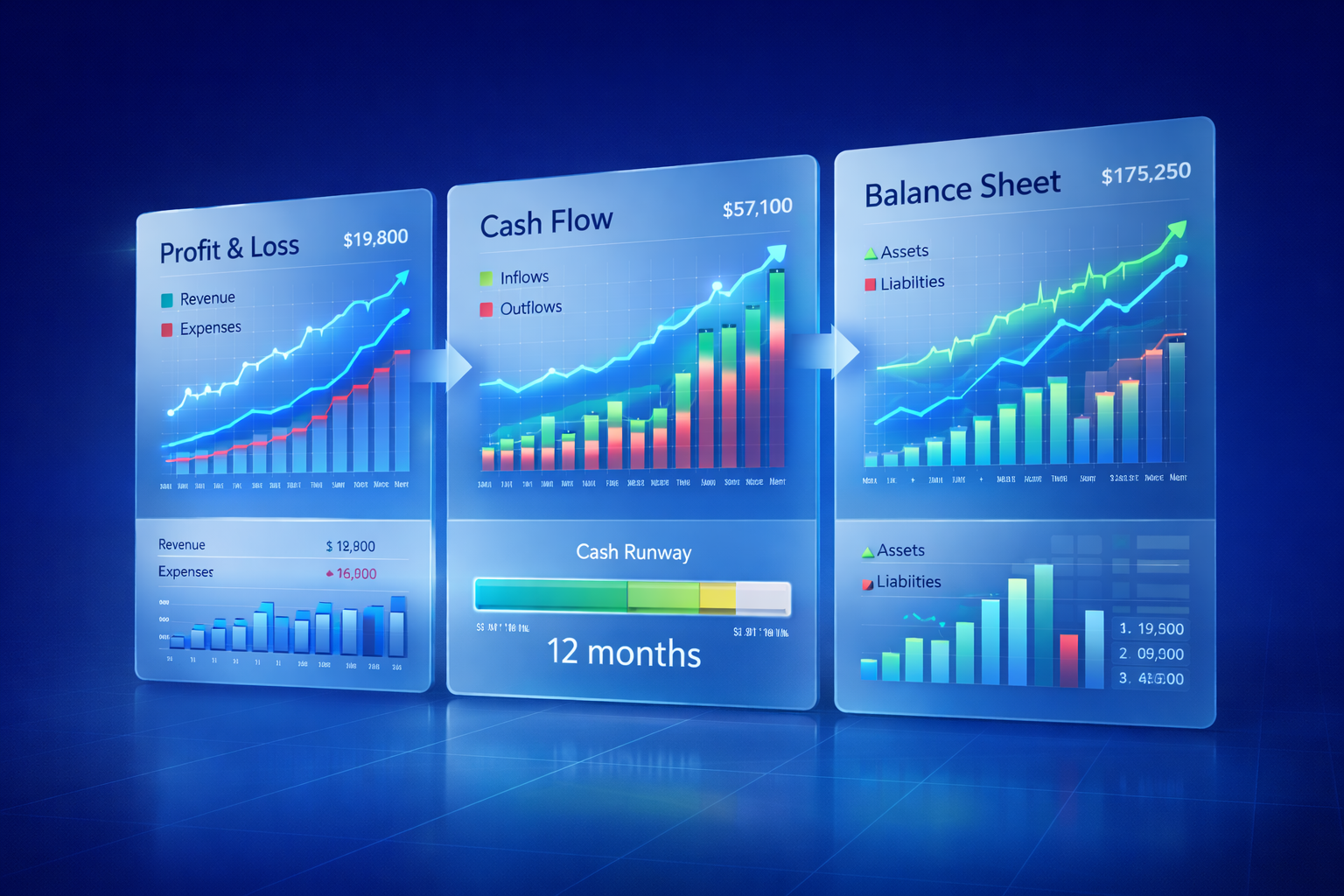
This financial model template helps you project your P&L, Cash Flow, and Balance Sheet in 30 minutes. See exactly when you’ll run out of cash—or turn profitable with this complete financial model template.
“This model helped us extend our runway by 8 months by identifying unnecessary expenses. The investor-grade projections made our seed round close in 3 weeks.”
📚 Trusted External Resources for Financial Modeling
These external resources provide additional context and best practices for financial modeling.
Interactive Financial Model Template
📊 Profit & Loss Summary (12 Months)
💰 Cash Flow & Runway
📋 Balance Sheet Highlights
🎯 Key Metrics
📉 Cash Runway Visualization
Green line = Breakeven point (if achieved)
Financial Modeling: A Complete Guide for Startup Founders
What Is a Financial Model?
A financial model is a spreadsheet that forecasts your startup’s future financial performance. It helps you understand how business decisions impact cash flow, runway, and profitability. For bootstrapped founders, a good financial model is essential for making informed decisions without relying on investors.
Why Every Bootstrapped Founder Needs a Financial Model
- Extend runway: Identify where you’re overspending before it’s too late
- Test scenarios: See how hiring, pricing changes, or marketing spend affect your cash
- Set realistic goals: Know exactly what revenue you need to reach profitability
- Fundraising readiness: When you do seek investment, you’ll have professional projections ready
- Peace of mind: Replace guesswork with data-driven planning
Key Components of a Startup Financial Model
1. Revenue Model
Project your revenue based on your pricing strategy. For SaaS, this includes:
- Number of customers (new, existing, churned)
- Average Revenue Per Account (ARPA)
- Monthly Recurring Revenue (MRR) growth
- Annual Recurring Revenue (ARR)
- Expansion revenue (upsells, cross-sells)
2. Cost Structure
Break down your expenses into fixed and variable costs:
- Fixed costs: Salaries, software subscriptions, rent — don’t change with revenue
- Variable costs: Marketing spend, payment processing fees, contractor costs — scale with growth
- One-time costs: Legal fees, equipment, initial development
3. Cash Flow Statement
Track money in and out of your business. This is your most important forecast because it shows your runway. Include:
- Beginning cash balance
- Cash inflows (revenue collections, investments)
- Cash outflows (expenses, one-time purchases)
- Ending cash balance
- Runway calculation
4. Key Metrics Dashboard
Track the metrics that matter for SaaS businesses:
- MRR/ARR: Monthly and annual recurring revenue
- Churn rate: Percentage of customers lost each month
- Customer Acquisition Cost (CAC): Cost to acquire a new customer
- Lifetime Value (LTV): Total revenue from a customer over their lifetime
- LTV:CAC ratio: Should be 3:1 or higher
- Gross margin: Revenue minus cost of goods sold
- Burn rate: Net cash spent per month
- Runway: Months until cash reaches zero
How to Build Your First Financial Model
- Start with revenue projections: Be conservative. Assume slower growth than you hope for.
- List all expenses: Don’t forget small items like software subscriptions and bank fees.
- Build a cash flow statement: This shows your actual runway month by month.
- Create scenarios: Build a “base case” (realistic), “best case” (optimistic), and “worst case” (conservative).
- Update monthly: Compare actuals to projections. Adjust your model as you learn.
- Use our template: Download the Financial Model Template below to get started with pre-built formulas.
Common Financial Model Mistakes to Avoid
- Over-optimistic revenue projections: Most startups take 2-3x longer to reach revenue targets than planned.
- Underestimating expenses: Add a 10-20% buffer for unexpected costs.
- Ignoring seasonality: Revenue may dip in summer or December.
- Forgetting payment terms: Revenue ≠ cash. If you bill annually, cash comes upfront but revenue is recognized monthly.
- Not updating regularly: A stale model is worse than no model.
How This Template Helps You Extend Runway
Our Financial Model Template is designed specifically for bootstrapped SaaS founders. It includes:
- Pre-built formulas for MRR, ARR, churn, and CAC
- Automatic runway calculation based on your cash balance and burn rate
- Scenario planning — test different pricing, hiring, and growth assumptions
- Visual dashboards to track key metrics at a glance
- 12-month monthly and 3-year annual forecasts
Download it below and start planning your path to profitability — without loans, debt, or interest.
📥 Download Free Financial Model Template
Get the complete financial model template with 12-month detailed projections, charts, and scenario planning.
Includes: P&L, Cash Flow, Balance Sheet, Charts, and 3 scenarios
How to Use This Financial Model Template in 30 Minutes
Enter Your Starting Position
Start using this financial model template by pulling your actual bank balance, last month’s revenue, and total expenses from your bank statements. Be accurate—garbage in = garbage out.
Set Realistic Growth Rates
For bootstrapped SaaS, 10% monthly growth is strong. 5% is solid. Be conservative—it’s better to be surprised than to run out of cash.
Review Your Runway
Look at the ending cash balance. If it’s negative, you have a problem to solve now. Options: cut costs, increase prices, or start fundraising.
Download & Update Monthly
Get the Excel version. Every month, replace forecasted numbers with actuals and adjust forward assumptions. This 30-minute habit prevents cash crises. For advanced techniques, see Wall Street Prep’s modeling guide.
Calculate Your Break-Even Point
Now that you know your runway and burn rate, find out how many customers you need at your current pricing. Use our SaaS Break-Even Calculator to set your customer acquisition targets and plan for profitability.
Financial Model Template: Frequently Asked Questions
12-18 months is ideal for bootstrapped startups. Less than 12 months doesn’t give enough warning for fundraising. More than 18 months is pure fantasy—too many unknowns.
For bootstrapped SaaS: 10-20% is exceptional, 5-10% is strong, under 5% is typical for mature products. Be honest with yourself—overly optimistic forecasts hide real problems.
Yes if you have accounts receivable (customers who pay later) or accounts payable (bills you haven’t paid). Investors will ask for it. But start with P&L and cash flow if you’re overwhelmed.
Monthly, right after you close your books. Compare actuals to forecast, understand why you were wrong, and adjust forward projections. This 30-minute habit is non-negotiable.
You have three options: 1) Cut expenses aggressively, 2) Increase revenue (raise prices, sell more), or 3) Start fundraising immediately. Don’t wait—runway disappears faster than you think.
Your financial model shows your monthly burn rate and revenue. To find exactly how many customers you need at your current pricing, use our SaaS Break-Even Calculator. It takes your fixed costs, ARPU, and variable costs to give you the precise customer count needed for profitability.