
Tree Recursion Guide : Free Online Solution
Master binary tree traversals — preorder, inorder, and postorder — with visual diagrams and recursive code examples.
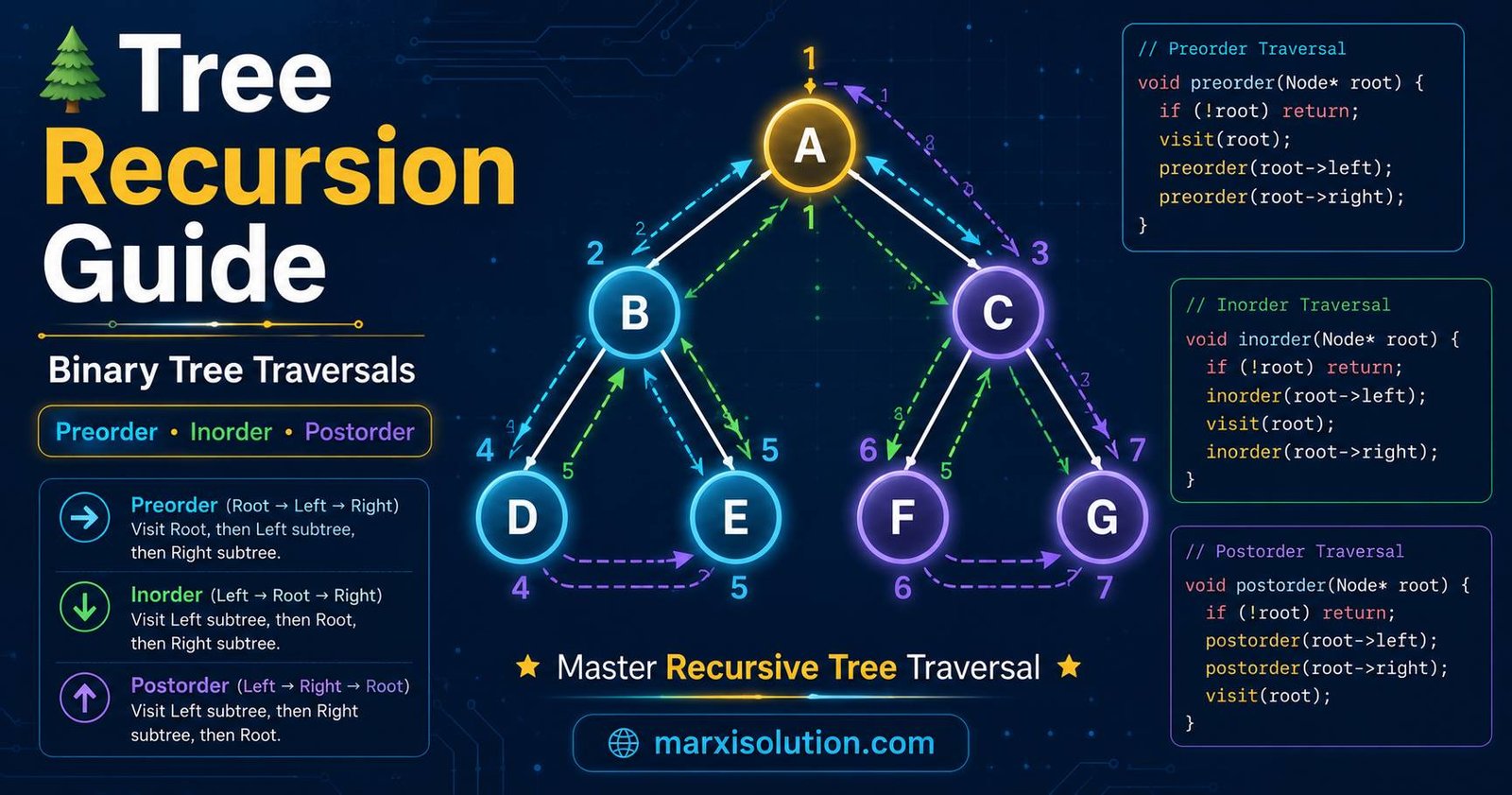
Visualize binary tree traversals: preorder, inorder, and postorder. Perfect for CS students learning recursive tree traversal.
Home → CS Student Hub → Tree Recursion Guide
This Tree Recursion Guide is your complete resource for understanding binary tree traversal techniques. The three essential traversal methods — preorder traversal, inorder traversal, and postorder traversal — are explained with visual diagrams and recursive code examples.
🌲 In this tree recursion guide, you’ll learn:
From Student to Founder
Master tree recursion now. When you’re ready to start your own IT business, we provide the infrastructure — no loans, no debt, no equity loss.
Learn How We Help Founders →What is a Binary Tree?
Before diving into tree recursion, let’s review the fundamentals.
A binary tree is a hierarchical data structure where each node has at most two children — a left child and a right child. The topmost node is called the root. Nodes without children are called leaves. Tree recursion naturally applies to binary trees because each node can be processed recursively, making recursive tree traversal the most elegant way to visit all nodes.
Example Binary Tree
├── B (Left)
│ ├── D
│ └── E
└── C (Right)
├── F
└── G
In this tree recursion guide, we’ll traverse this tree using all three methods.
Preorder Traversal (Root → Left → Right)
Visit the root first, then recursively traverse the left subtree, then the right subtree.
🔑 How Preorder Traversal Works:
- Visit the root node (process its data)
- Recursively do a preorder traversal of the left subtree
- Recursively do a preorder traversal of the right subtree
💻 Recursive Code (Python)
For the example tree above, preorder traversal visits: A → B → D → E → C → F → G
📊 Visual Walkthrough
Preorder traversal visits the root before its children.
Inorder Traversal (Left → Root → Right)
Recursively traverse the left subtree, visit the root, then traverse the right subtree.
🔑 How Inorder Traversal Works:
- Recursively do an inorder traversal of the left subtree
- Visit the root node (process its data)
- Recursively do an inorder traversal of the right subtree
💻 Recursive Code (Python)
For the example tree, inorder traversal visits: D → B → E → A → F → C → G
📊 Visual Walkthrough
Inorder traversal visits the root between its left and right subtrees.
💡 Binary search trees produce sorted output with inorder traversal.
Postorder Traversal (Left → Right → Root)
Recursively traverse the left subtree, then the right subtree, then visit the root.
🔑 How Postorder Traversal Works:
- Recursively do a postorder traversal of the left subtree
- Recursively do a postorder traversal of the right subtree
- Visit the root node (process its data)
💻 Recursive Code (Python)
For the example tree, postorder traversal visits: D → E → B → F → G → C → A
📊 Visual Walkthrough
Postorder traversal visits the root after both its children.
💡 Used for deleting trees or evaluating expression trees.
Tree Traversal Methods Compared
A side-by-side comparison of the three binary tree traversal techniques.
| Traversal | Order | Example Output | Common Use |
|---|---|---|---|
| Preorder | Root → Left → Right | A, B, D, E, C, F, G | Copying trees, prefix expressions |
| Inorder | Left → Root → Right | D, B, E, A, F, C, G | BST sorted output, infix expressions |
| Postorder | Left → Right → Root | D, E, B, F, G, C, A | Deleting trees, postfix expressions |
💡 All three traversals use tree recursion with O(n) time complexity, visiting each node exactly once.
Recursive vs Iterative Tree Traversal
Understanding the trade-offs between recursive and iterative approaches.
Recursive Approach
- ✅ Elegant and concise code
- ✅ Naturally follows tree structure
- ✅ Easy to understand and implement
- ⚠️ Uses O(h) stack space
- ⚠️ Risk of stack overflow for deep trees
Iterative Approach
- ✅ Avoids recursion limit issues
- ✅ Uses explicit stack (O(h) space)
- ✅ More control over memory
- ⚠️ More complex code
- ⚠️ Harder to read and maintain
Which to Choose?
- 📚 Learning: Use recursive
- 🏢 Production: Consider iterative for deep trees
- 🧪 Interviews: Know both!
Tree Traversal Visualizer
See recursive tree traversal in action with our interactive visualizer.
Coming Soon: Tree Traversal Visualizer
Watch preorder, inorder, and postorder traversals animate step-by-step.
Tree Recursion Practice Problems
Test your understanding of binary tree traversal with these problems.
Problem 1: Identify the Traversal
Given the output A, B, D, C, E, F, which tree traversal is this?
Show Answer →
Answer: Preorder Traversal
Root is visited first (A), then left subtree (B, D), then right subtree (C, E, F).
Problem 2: Construct from Traversals
Preorder: A, B, D, E, C, F
Inorder: D, B, E, A, F, C
What is the postorder traversal?
Show Answer →
Answer: D, E, B, F, C, A
Postorder = Left → Right → Root
Problem 3: BST Inorder
For a binary search tree with values 10, 5, 15, 3, 7, 12, 20, what is the inorder traversal?
Show Answer →
Answer: 3, 5, 7, 10, 12, 15, 20
Inorder traversal of a BST produces sorted order.
Quick Reference Cheat Sheet
Quick reference for all binary tree traversal methods.
🔵 Preorder
Root → Left → Right
Copy trees
🟢 Inorder
Left → Root → Right
BST sorted order
🟣 Postorder
Left → Right → Root
Delete trees
📐 Recursion Formula
T(n) = T(left) + T(right) + O(1)
O(n) time, O(h) space
📖 Frequently Asked Questions
📌 What is tree recursion? ▼
Tree recursion is a recursive approach where a function calls itself on each child node of a tree data structure. In binary trees, the function typically makes two recursive calls — one for the left subtree and one for the right subtree. This is the foundation of binary tree traversal techniques like preorder, inorder, and postorder.
📌 What is the difference between preorder, inorder, and postorder traversal? ▼
Preorder traversal visits the root before its children (Root → Left → Right). Inorder traversal visits the root between its children (Left → Root → Right). Postorder traversal visits the root after its children (Left → Right → Root). Each has different applications: preorder for copying trees, inorder for sorted output in BSTs, and postorder for deleting trees.
📌 Why is inorder traversal of a BST sorted? ▼
In a Binary Search Tree (BST), the left subtree contains smaller values, and the right subtree contains larger values. Inorder traversal visits left subtree → root → right subtree, which naturally produces values in ascending order. This makes inorder traversal the standard way to retrieve sorted data from a BST.
📌 How do I choose between recursive and iterative tree traversal? ▼
Use recursive tree traversal when learning or when tree depth is manageable (h < 1000). It's more elegant and easier to understand. Use iterative traversal when working with very deep trees that risk stack overflow, or when you need explicit control over memory usage. For coding interviews, knowing both approaches is recommended.
Additional Resources
Explore more tools and resources for computer science students.
Still Stuck? We’re Here to Help
Can’t figure out a tree traversal problem? Submit your question and we’ll help you understand tree recursion step by step.
Submit Your Question — Get a Step-by-Step Solution
One of our CS experts will review your question and send you a detailed explanation within 24-48 hours. Free. No strings attached.
📋 Before you submit:
- Share the tree traversal problem you’re working on
- Include the tree structure or traversal you’re trying to understand
- Tell us where you’re getting confused
Fill out the form below
🔒 Your email is safe with us. We’ll never share your information.
⚠️ Important Disclaimer
We aim to respond within 24-48 hours, but response times may vary. Our guidance is meant to help you learn — not to replace your own work or your professor’s instruction.
Get More CS Resources
Subscribe to get new tree recursion examples, practice problems, and CS study guides delivered to your inbox.
No spam. Unsubscribe anytime.