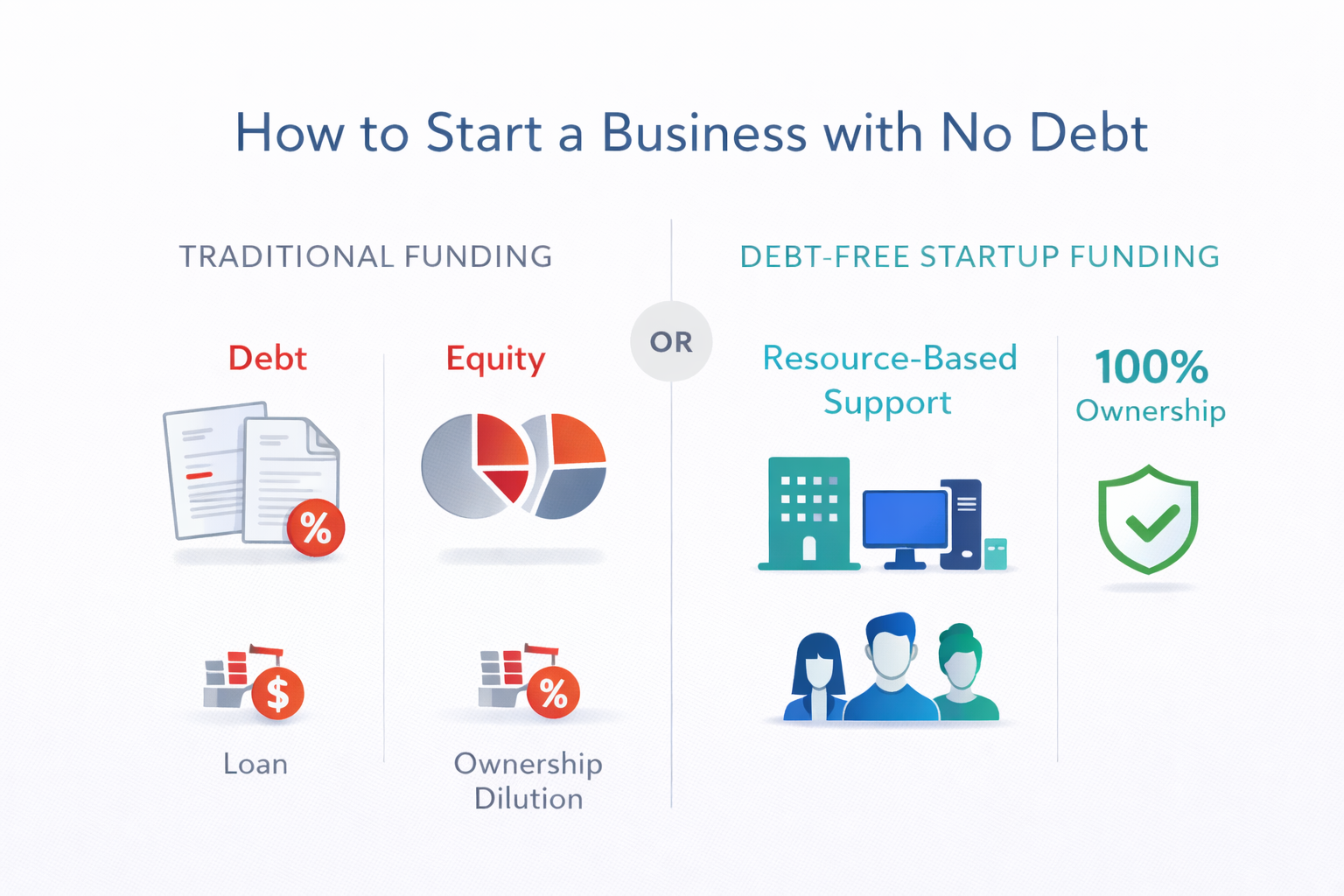
How to start a business with no debt is one of the biggest questions IT founders ask.
This comprehensive guide answers your questions about how to start a business with no debt through non-traditional funding, business planning,
and alternative support models – helping you launch or grow without loans or equity dilution.
0%
Debt & Interest
100%
Equity Retention
10-15
Days to Launch
FEATURED GUIDE
Our comprehensive approach to how to start a business with no debt combines strategic planning with alternative funding models.
How to Start a Business with No Debt: Core Funding Concepts
These FAQs address the fundamentals of how to start a business with no debt and understand your funding options.
The primary models are:
Debt
Loans you repay with interest
Equity
Selling ownership shares
Grants
Non-repayable funds
Bootstrapping
Using personal savings/revenue
Alternative models, like asset-based support, provide resources instead of cash—offering a path to launch without debt or equity loss.
Bootstrapping means funding your business solely through personal finances and operating revenue, without external investment.
Main Challenges:
Limited initial resources can slow growth and product development
Increased founder personal risk as personal assets are on the line
Difficulty competing with well-funded competitors in fast-moving markets
Potential for founder burnout due to wearing multiple hats
This refers to funding models where a business receives physical resources instead of, or in addition to, financial capital.
Examples of Provided Resources:
🏢
Office Space
💻
IT Hardware
👥
Operational Support
⚡
Utilities
Key Benefit: This approach reduces upfront debt and allows founders to retain full equity while accessing the infrastructure needed to operate.
How to Start a Business with No Debt: Planning & Strategy
This typically involves a structured process to ensure legal compliance and protect your business:
Recommended Legal Steps:
Register your business entity (LLC, Corporation, etc.)
Obtain necessary tax identifications (EIN, VAT if applicable)
Secure intellectual property rights for software/code through copyrights or patents
Ensure compliance with local digital service regulations and data protection laws (like GDPR)
Draft client contracts and service agreements
Set up proper accounting and bookkeeping systems
Note: Requirements vary by country and region. Consulting with a local business attorney is recommended.
At a minimum, a new IT firm requires both physical and digital infrastructure to operate effectively:
Physical & Hardware
Reliable workstations/computers
Development & testing servers
Networking equipment
Professional business address
Software & Tools
Development environments (IDEs)
Project management tools
Secure communication platforms
Version control systems
Scalable cloud services (like AWS, Azure, Google Cloud) are often crucial as they allow you to start small and grow your infrastructure with demand, converting capital expenses to operational expenses.
A clear business plan is vital, even when not seeking traditional funding. It serves as your strategic roadmap and decision-making framework.
Key Elements Your Business Plan Should Address:
🎯
Market Definition
💡
Value Proposition
📈
Operational Strategy
📊
Growth Metrics
Your business plan guides your decision-making regardless of your funding source. For resource-based funding models, it demonstrates your strategic thinking and operational readiness to potential partners.
Asset-Based Models: How to Start a Business with No Debt
This section addresses common questions about funding models where businesses receive resources instead of cash, focusing on practical implementation and long-term viability.
Eligible businesses receive access to tangible resources without an upfront capital investment or loan:
Typical Resource Package Includes:
🏢
Equipped Workspaces
Ready-to-use offices
💻
IT Infrastructure
Hardware & servers
👥
Admin Support
HR & operational help
This approach allows operations to begin immediately while preserving equity and avoiding debt. Founders can focus on building their business rather than managing infrastructure setup.
Eligibility typically focuses on business viability rather than financial history:
Specific requirements vary by provider, but the emphasis is generally on the business’s potential for success rather than traditional credit metrics.
In pure resource-based models, yes. Founders retain 100% equity and operational control.
🎯
100% Founder Control
Complete ownership, decision-making authority, and creative direction
The provider’s role is to supply resources, not govern the business. This distinguishes resource-based models from traditional equity investments where investors often require board seats and influence over strategic decisions.
Key Distinction: Unlike venture capital (which exchanges cash for equity and control) or loans (which create repayment obligations), resource-based support provides infrastructure while maintaining founder autonomy.
The primary benefits stem from avoiding financial burdens that can hinder early-stage growth:
Traditional Loan Costs
Debt repayment obligations
Interest costs (often 5-15% APR)
Equity dilution if convertible
Personal/business collateral risk
Fixed monthly payments regardless of revenue
Resource Model Benefits
No debt repayment
Zero interest costs
No equity dilution
No personal collateral required
Flexibility aligned with business performance
This structure significantly improves cash flow in the early stages and reduces financial risk for the founder, allowing more resources to be reinvested into growth initiatives.
Yes. These models are often designed for the launch and early-growth phase. As a business succeeds, it can reinvest its revenue to secure additional or upgraded resources independently.
Ready to Start Your Debt-Free IT Business?
Get the resources and support you need without loans, debt, or equity loss.