

SaaS Break-Even Calculator:
Find Your Customer Target
Calculate exactly how many customers your subscription business needs to become profitable
Understanding SaaS Break-Even Analysis
For bootstrapped SaaS founders, knowing your break-even point isn’t just accounting—it’s survival. The question “how many customers to break even” is typically the first one investors ask and the metric every founder should track monthly.
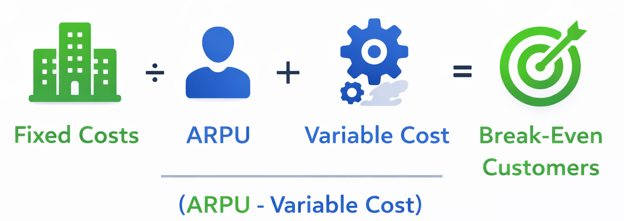
The SaaS break-even formula visualized
Why Break-Even Matters for Startups
Your break-even point determines your runway requirements, pricing strategy, and fundraising needs. According to CB Insights research, running out of cash is the #2 reason startups fail. A SaaS with $15,000 monthly fixed costs and $49 ARPU needs 441 customers to break even before runway runs out.
Three Ways to Improve Your Break-Even
1. Increase ARPU
Raise prices, add premium tiers, or implement usage-based pricing. A 20% ARPU increase from $49 to $59 reduces break-even customers from 441 to 340.
2. Reduce Fixed Costs
Start lean: use remote teams, open-source tools, and avoid long-term commitments. Cutting fixed costs by 20% ($15,000 to $12,000) drops needed customers to 353.
3. Optimize Variable Costs
Negotiate payment processing, optimize cloud costs, automate support. Reducing variable cost from $15 to $10 increases contribution margin to $39, needing only 384 customers.
Break-Even vs. Runway: Critical Connection
Your break-even point directly impacts burn rate and runway. If you need 441 customers but only add 15 per month, you need 29 months to break even. With $15,000 monthly burn, you need $435,000 in funding to reach profitability.
SaaS Unit Economics Deep Dive
Beyond basic break-even, sophisticated founders calculate:
- Payback period: Months to recover customer acquisition cost
- LTV:CAC ratio: Lifetime value vs. acquisition cost (target >3:1)
- Contribution margin: Revenue minus variable costs (should be 70-80%)
- Break-even with churn: Factoring in customer churn requires 15-20% more customers
Frequently Asked Questions
What’s a good break-even point for a SaaS?
For bootstrapped SaaS, aim to break even within 12-18 months. This typically requires 200-500 customers depending on pricing. Enterprise SaaS often breaks even with 50-100 customers at higher price points.
How does churn affect break-even?
With monthly churn, you need 15-25% more customers to maintain break-even. For example, if your break-even is 400 customers with zero churn, at 5% monthly churn you need 480 customers to stay at break-even.
Should I include my salary in fixed costs?
Yes. Include a market-rate salary for yourself, even if you’re not taking one yet. This ensures your business model is sustainable when you eventually pay yourself.
How often should I recalculate break-even?
Monthly, or whenever your costs or pricing change. Many founders recalculate quarterly and always before fundraising discussions.
What’s the difference between break-even and payback period?
Break-even is total customers needed to cover all costs. Payback period is months to recover the cost of acquiring one customer. Both are essential metrics.
Can I break even with negative contribution margin?
No. If variable costs exceed ARPU, you lose money on every customer and can never break even. Fix your unit economics first.
Last updated: March 2026 • Use this SaaS break-even calculator to plan your path to profitability