

Every day, thousands of aspiring founders search for “bootstrapping startup business” hoping to find a clear, actionable roadmap. What they usually find is generic advice: “cut costs,” “work from home,” “use free tools.” That advice is not wrong, but it is incomplete.
Bootstrapping startup business means building a company using your own savings and revenue – not venture capital, not bank loans, not angel investors. You keep full ownership, full control, and all the upside. But you also bear all the risk.
This playbook is for SaaS founders who want to bootstrap a technology company from zero to sustainable revenue. No fluff. No motivational speeches. Just tactical steps, real numbers, and a clear framework to get you to 5K-10K MRR (Monthly Recurring Revenue).
If you are serious about bootstrapping a startup business, you need a different mindset than VC-funded founders. You do not have millions in the bank. You cannot hire a team of engineers before you have customers. You must be profitable from day one or at least within months.
Here is exactly how to do it.
Chapter 1: What Is Bootstrapping a Startup Business?
Bootstrapping a startup business is the practice of funding your company entirely through personal savings, early customer revenue, and organic growth. You do not raise outside capital. You do not give away equity. You build slowly, deliberately, and profitably.
The term startup bootstrapping comes from the phrase “pulling yourself up by your bootstraps.” It is a fitting metaphor because bootstrapped founders rely entirely on their own resources and effort.
For SaaS founders specifically, what is bootstrapping in business looks like this:
- You build the first version of your product yourself (or with one co-founder)
- You launch quickly and charge from day one
- You reinvest revenue back into the product
- You grow at a sustainable pace, not a VC-funded “growth at all costs” pace
In contrast, VC-funded startups raise millions before they have product-market fit. They hire aggressively. They burn cash. And most of them fail, not because the product is bad, but because they run out of money before finding a sustainable business model.
Bootstrapping a business is the opposite. You grow only when you have paying customers. Your revenue is your fuel. Your profitability is your survival.
Chapter 2: Is Bootstrapping a Startup Business Right for You?
Before you commit to bootstrapping a startup business, ask yourself these four questions:
| Question | If Yes → Bootstrapping Makes Sense | If No → Consider VC or Angel Funding |
| Do you want to keep full ownership and control? | ✅ Yes | ❌ You are fine giving equity |
| Can you reach profitability with 100-500 customers? | ✅ Yes | ❌ You need millions of users to succeed |
| Do you have 12-24 months of personal savings? | ✅ Yes | ❌ You need a salary immediately |
| Is your market well-understood and accessible? | ✅ Yes | ❌ You need to educate an entirely new market |
Bootstrapping a business works best for B2B SaaS, vertical SaaS, and developer tools. These markets have clear problems, willing buyers, and predictable customer acquisition costs.
Bootstrapping startup is harder for marketplaces, social networks, and consumer apps. These often require network effects and massive scale before revenue materializes.
If you are building a tool for small businesses, freelancers, agencies, or developers, startup bootstrapping is likely your best path.
Chapter 3: The Financial Reality of Bootstrapping a Startup Business
Let us talk numbers. Bootstrapping a startup business is not free. You need to survive while you build.
How Much Money Do You Need?
For a solo founder in the US or Europe, the typical requirement is $15,000 to $30,000 in savings. This covers 6 to 12 months of personal living expenses while you build your MVP and acquire your first paying customers.
If you have a co-founder, double that number.
What Revenue Target Should You Aim For?
Bootstrapping startup business becomes sustainable when you reach $5,000 to $10,000 MRR (Monthly Recurring Revenue). At 5K MRR, you can cover your personal expenses. At 10K MRR, you can reinvest into the business and potentially hire your first contractor.
What Operating Costs Can You Expect?
A lean, bootstrapped startup SaaS can run on $200 to $300 per month. Here is a realistic breakdown:
| Expense Category | Monthly Cost (Approx.) |
| Cloud hosting (Hetzner, Vultr) | $10 – 20 |
| Database (Neon, Supabase free tier) | $ 0 – 10 |
| Payment processing (Stripe) | 2.9% + $ 0.30 per transaction |
| Analytics (Plausible, PostHog free) | $ 0 – 9 |
| Email (Resend, Postmark) | $0 – 20 |
| Support chat (Crisp) | $ 25 |
| Lifecycle emails (Loops) | $ 29 |
| Total | $ 200 – 300 |
When you are a bootstrapping startup, every dollar counts. Avoid expensive tools like until you have meaningful revenue.
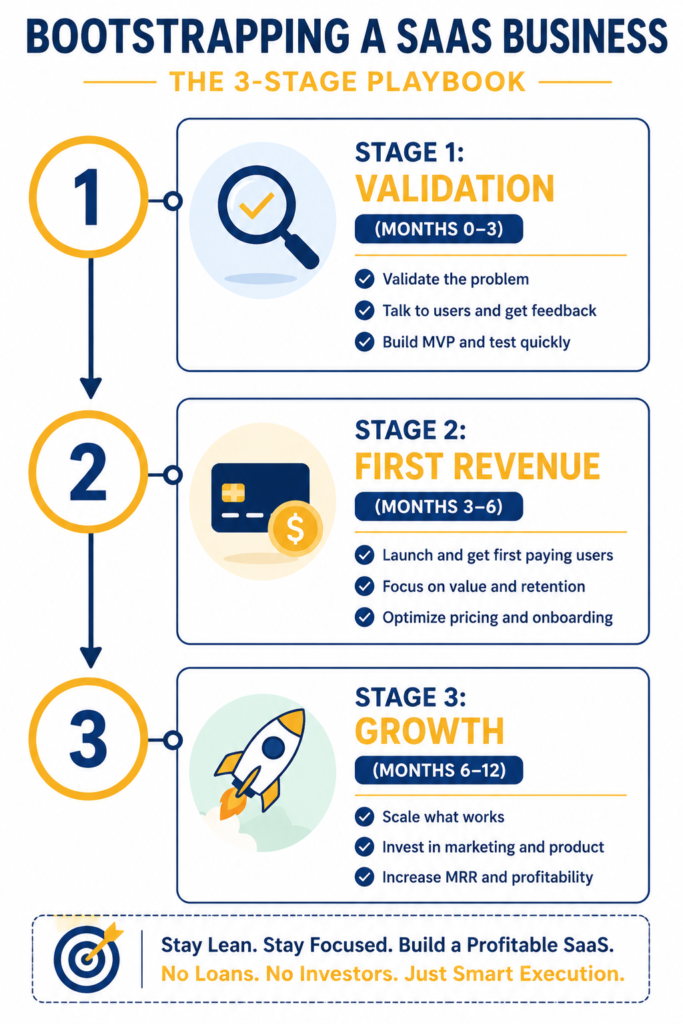
Chapter 4: The 3-Stage Bootstrapping Playbook
Here is the tactical framework for bootstrapping startup business from zero to sustainable revenue.
Stage 1: Validation (Months 0 – 3)
Before you write a single line of code, validate that someone will pay for your solution.
Step 1 – Find a painful problem: The best opportunities for bootstrapping startup business come from problems you have personally experienced. Look for workflows that are broken, manual, or painfully slow.
Step 2 – Talk to potential customers: Interview at least 10 people who have the problem. Ask open-ended questions. Do not pitch your solution yet.
Step 3 – Pre-sell before you build: Create a simple landing page. Explain the problem and your proposed solution. Offer a lifetime deal or a discounted annual plan. Collect credit card numbers before you write code. If you cannot get a paid commitment, you do not have product-market fit.
Step 4 – Scope ruthlessly:
Your MVP should solve exactly one core problem. Nothing more. A good rule of thumb for a bootstrapping startup business is: if you cannot build it in 4 – 8 weeks, it is too big.
Stage 2: First Revenue (Months 3–6)
Your goal in this stage is to get your first 10–20 paying customers.
Step 1 – Launch with a price: Charge from day one. Do not offer a free tier. A common mistake in a bootstrapping startup business is underpricing. Start at $50 – $100 per month. If nobody buys, lower the price. If you get customers immediately, raise the price for new signups.
Step 2 – Use value-based pricing: If your tool saves a customer 10 hours per week at $50/hour, the value is $50/hour. Charge 10 – 20% of that value $50 – $100/month.
Step 3 – Find your first customers through manual outreach: For a bootstrapping startup business, your first customers will not come from SEO or paid ads. They will come from:
- Direct outreach on LinkedIn or email (50 – 100 personalized messages per week)
- Posting in niche communities (Reddit, Discord, Slack groups, Indie Hackers)
- Asking friends and former colleagues for introductions
Step 4 – Talk to every customer weekly: In the early stage of a bootstrapping startup business, every customer conversation is market research. Ask: “What almost stopped you from buying?” “What would make you cancel?” and “What is missing?”
Stage 3: Growth (Months 6 – 12)
Once you have 20+ paying customers and monthly churn below 5%, you can focus on scaling one acquisition channel.
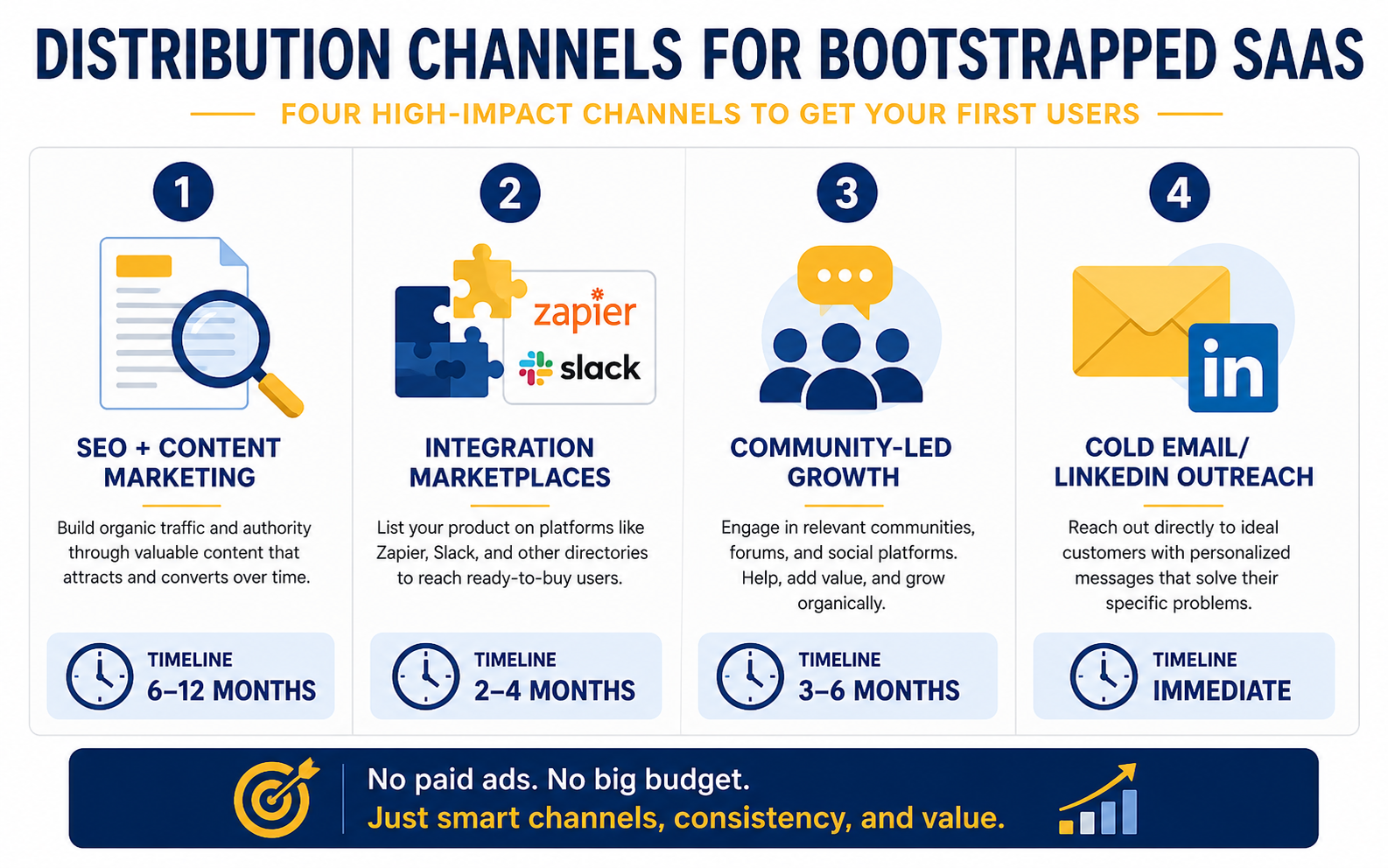
Step 1 – Choose one channel and go deep: The most reliable channels for a bootstrapping startup business are:
| Channel | Best For | Timeline |
| SEO + content marketing | Long-term, compounding growth | 6–12 months |
| Integration marketplaces (Zapier, Slack) | Fast, targeted acquisition | 2–4 months |
| Community-led growth | High-trust, low-cost | 3–6 months |
| Cold email/LinkedIn | Narrow, high-value audiences | Immediate |
Step 2 – For SEO, write 50 posts targeting low-competition keywords (KD 0–15): Examples:
- “Asana vs Monday comparison”
- “ClickUp alternative for freelancers”
- “How to solve slow client approval workflows”
Step 3 – For integrations, build for Zapier, Slack, or Airtable: List your integration in their marketplaces. Users discover you when searching for specific use cases like “meeting notes for Slack” or “lead capture for Zapier.”
Step 4 – Track your unit economics: Calculate your CAC (Customer Acquisition Cost) and LTV (Lifetime Value). For sustainable a bootstrapping startup business, LTV should be at least 3x CAC.
Chapter 5: A Bootstrapping Startup Business vs. Raising VC
Many founders ask: “Is bootstrapping startup business better than raising venture capital?” The answer depends on your goals.
| Factor | Bootstrapping | VC Funding |
| Ownership | 100% yours | 20 – 40% to investors |
| Control | Full | Board oversight, investor input |
| Pressure | Your own timeline | Aggressive growth targets |
| Failure rate | Lower (grow organically) | Higher (burn cash, run out of runway) |
| Exit options | Keep as profitable lifestyle business, sell for 2–5x revenue | Must grow to $100M+ ARR or IPO |
If you want to build a profitable, sustainable company that serves a specific niche, bootstrapping startup business is the better path.
If you are building a winner-take-all marketplace or a deep-tech hardware company, VC funding may be necessary.
Chapter 6: Common Mistakes in Bootstrapping a Startup Business
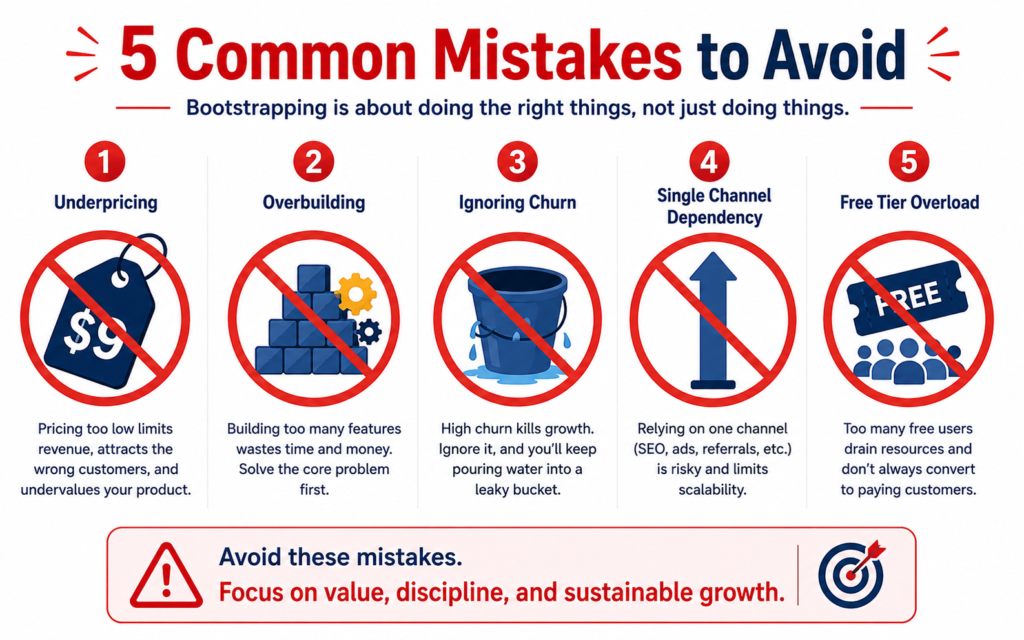
Avoid these pitfalls that kill most bootstrapped SaaS companies.
Mistake 1 – Underpricing: Charging $9 – $19/month forces you to acquire hundreds of customers before you are profitable. For bootstrapping a startup business, charge $50 – $100/month minimum.
Mistake 2 – Overbuilding before selling: Spending six months building a “perfect” product without customer feedback is fatal. Launch faster.
Mistake 3 – Ignoring churn: Monthly churn above 5% means your customer base will halve every 12 – 14 months. Fix retention before acquiring new customers.
Mistake 4 – Depending on one acquisition channel: SEO is great until Google updates its algorithm. Build multiple channels.
Mistake 5 – Giving away too much for free: Free tiers attract tire-kickers, not paying customers. For bootstrapping startup business, charge from day one or offer a time-limited free trial (14 – 30 days).
Chapter 7: From Bootstrapping a Startup Business to Scaling with Infrastructure
Following this playbook will get you to 5K – 10K MRR. You will have a functional SaaS, a small but loyal customer base, and positive unit economics.
But you will also be doing everything yourself. Customer support. Marketing. Product development. Sales. Operations. It is exhausting.
That is where asset-based resources providers come in.
Bootstrapping startup business should not mean doing everything alone. When you are ready to scale beyond your personal capacity, asset-based resources providers provide the infrastructure you need, without loans, debt, or equity loss.
They provide:
- Fully equipped office space
- High-end IT hardware and servers
- Skilled development and support teams
- Operational and administrative support
You keep 100% ownership. You keep all the upside. They simply provide the resources to help you grow faster.
This is called bootstrapping startup business with actual support. Not a loan. Not an investor. Just the infrastructure you need to start or scale.
Conclusion
Bootstrapping startup business is not the easiest path, but it is the most rewarding. You keep full ownership. You answer to no investors. You build at your own pace.
The playbook is simple: validate before you build, charge from day one, obsess over retention, and scale one distribution channel at a time.
It will take 12-18 months of focused work. You will face rejection, technical problems, and moments of doubt. But if you persist, you will own a profitable, sustainable SaaS business.
When you are ready to scale beyond your personal capacity, Asset-based resources providers provide the infrastructure, teams, and support you need to grow without debt or equity loss. Bootstrapping startup business is hard. You do not have to do it alone.
❓ Frequently Asked Questions
The information provided in this article is for educational and informational purposes only. It does not constitute financial, legal, or professional advice. Bootstrapping a startup business involves significant financial risk. You may lose some or all of your invested capital. Past performance and examples discussed are not guarantees of future results. Every startup funding decision carries risk. Always consult with qualified financial advisors, accountants, or legal professionals before making any business decisions. MarxisSolution does not assume any responsibility or liability for actions taken based on the content of this article. Unless otherwise noted, the tools, services, and platforms mentioned are trademarks of their respective owners. Their inclusion does not imply endorsement or affiliation.